





.webp)
Containerized Sewage Treatment Plants: What They Are & When to Choose One
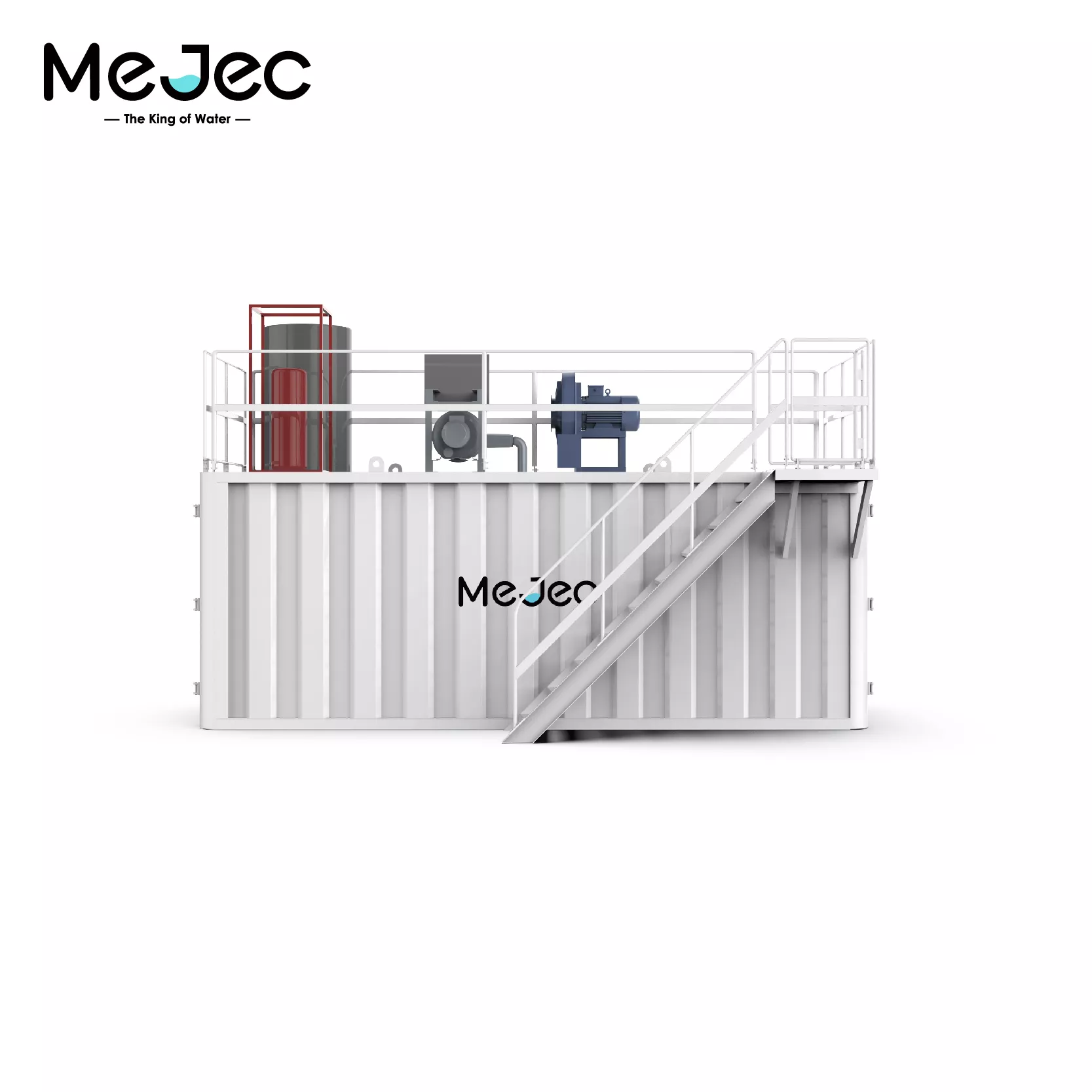
A containerized sewage treatment plant — or containerised, in British English — is a complete wastewater treatment system built inside a standard shipping container. Because everything is assembled and tested in the factory before it travels, a containerized STP can be treating sewage within days of arriving on site. This guide explains how these plants work, when they are the right choice, and what to look for when comparing suppliers.
What Is a Containerized Sewage Treatment Plant?
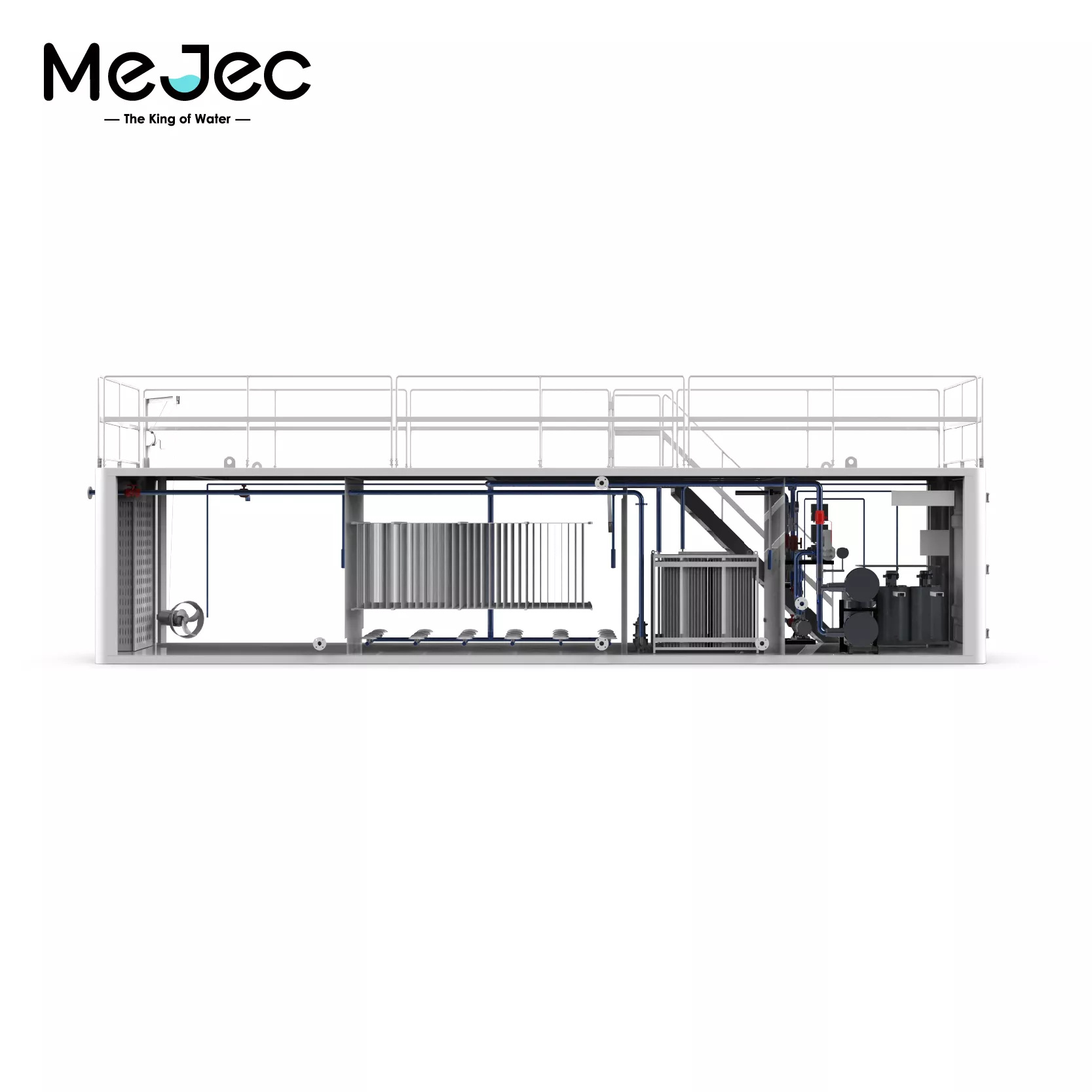
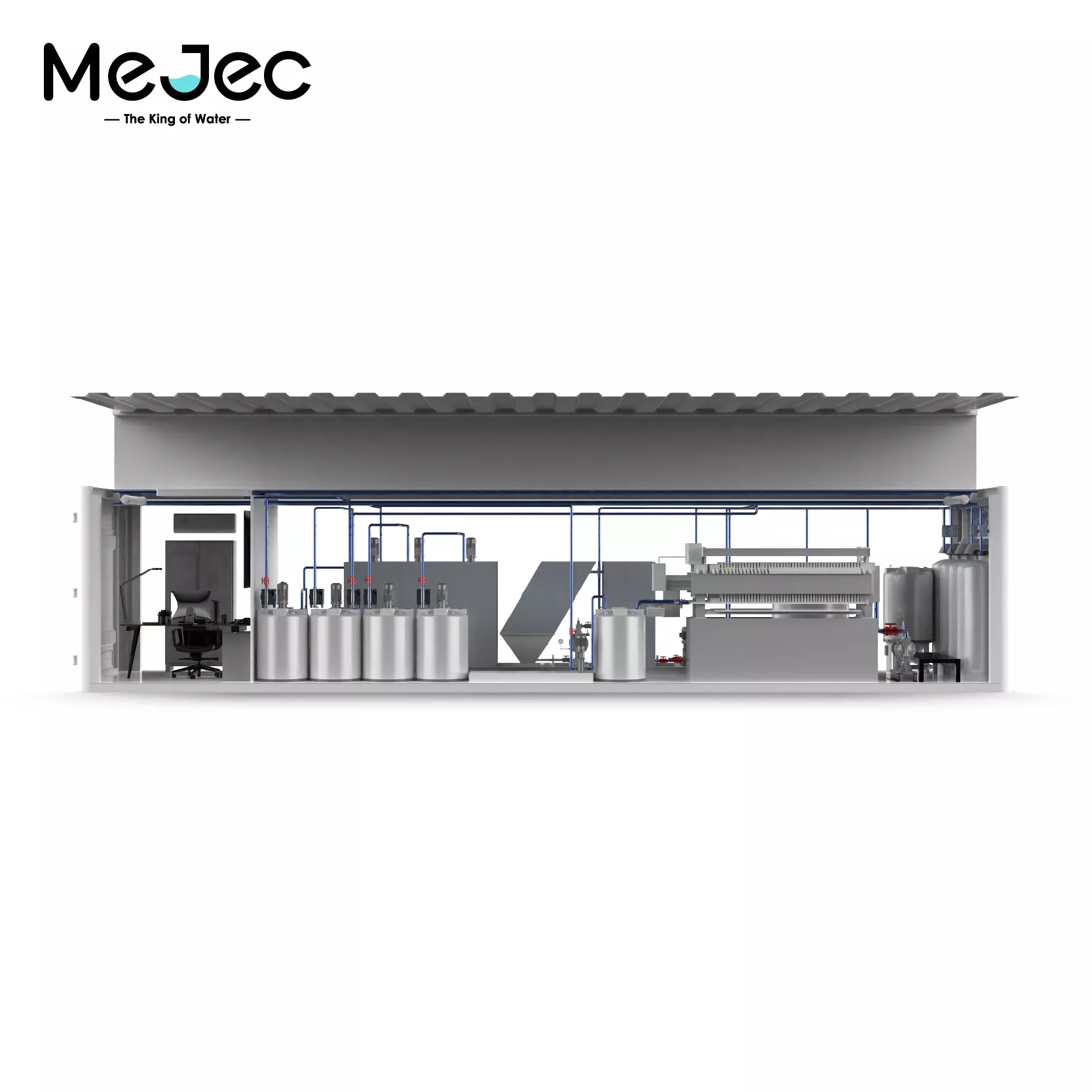
A containerized sewage treatment plant puts the entire treatment process inside the footprint of a standard intermodal container. Inside that steel shell you will find the biological treatment tank, the aeration system, blowers, the PLC control cabinet, pipework, disinfection, and the outlet pumps — all pre-wired and pre-plumbed. The plant is assembled in the factory, filled with water and hydro-tested, and shipped as one unit.
On arrival, the work left for the site team is intentionally small: a level concrete foundation, an inlet connection from the sewage source, a power supply, and an outlet to discharge or reuse. Water and power in, treated water out. That is why the category is so often described as plug-and-play sewage treatment.
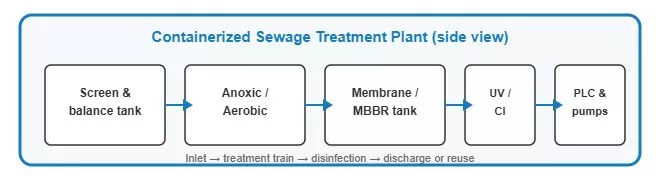
How a Containerized STP Works
The process inside a containerized plant is the same biological treatment you would find in a conventional sewage works, compressed into a fraction of the space. The stages are straightforward:
Screening and balancing. Raw sewage passes through a screen to remove solids, then enters a balance tank that smooths the peaks and troughs of daily flow so the biology is not shocked.
Biological treatment. Bacteria break down organic pollutants. Depending on the configuration this may use anoxic and aerobic zones, moving bed biofilm carrier media (MBBR), or membrane bioreactor (MBR) separation for higher effluent quality.
Disinfection. UV or chlorine dosing kills pathogens in the treated water.
Control and monitoring. A PLC cabinet runs the blowers and pumps automatically, and remote monitoring can report alarms and operating data to the manufacturer.
The result is treated effluent that meets the discharge standard the plant was engineered for — for example BOD5 near 10 mg/L, ammonia nitrogen near 5 mg/L and suspended solids near 5 mg/L on a well-run MBR train — which is clean enough for surface discharge in many jurisdictions, or for reuse in irrigation and toilet flushing where permitted.
When Should You Choose a Containerized Sewage Treatment Plant?
Containerized plants are not the right answer for every project, but they are an increasingly obvious answer for a specific set of situations. Consider them when any of the following apply:
You Need Speed
Because the plant arrives complete, the schedule is measured in days of site work rather than months of civil construction. Projects with a fixed opening date — a resort, a camp, a housing development phase — benefit the most. Factory prefabrication typically shortens the overall timeline by 30-50% compared with built-in-place construction.
There Is No Sewer to Connect To
Remote lodges, mining camps, highway service areas, construction sites and communities outside the municipal network all need on-site treatment. A containerized plant treats the sewage where it is produced instead of waiting for a pipeline that may never arrive.
You May Need to Move or Resize Later
A containerized plant is relocatable: it can be lifted onto a truck and moved when a project ends or expands. For phased developments, additional containers can be added as population grows, which spreads capital spending instead of front-loading it.
Site Conditions Favour Above-Ground Equipment
High groundwater, rock, or shallow bedrock can make buried tanks expensive or impossible. A containerized plant sits on a level foundation at ground level, avoiding deep excavation entirely.
You Want Factory Quality Control
Every weld, every pipe joint and every wire is installed under factory conditions and tested before shipment. That level of quality control is difficult to reproduce on a construction site, which is one reason containerized plants have such consistent performance records.
When a Containerized Plant Is NOT the Best Fit
Honesty about the limits is part of good engineering. A containerized STP may be the wrong choice when the project needs a very large municipal-scale facility with a dedicated operator and decades of fixed infrastructure, or when the site genuinely has no space for a container footprint and a buried tank under existing ground is preferable. For single homes and small villas, a compact buried Johkasou unit is usually more economical than a full container. The right scale is a design decision, not a preference.
Containerized vs Buried vs Concrete: Quick Comparison
Factor | Containerized STP | Buried Johkasou / Package Plant | Built-in-Place Concrete |
|---|---|---|---|
Footprint | Container at ground level | Underground; surface stays usable | Large excavation and structures |
Speed | Fastest; days of site work | Fast; small excavation | Slowest; months typical |
Relocatable | Yes, truck to new site | Difficult | No |
Typical scale | 50-600 m³/d per unit, combinable | 1-100 m³/d | Any, but long lead |
Factory testing | Full hydro-test before shipment | Factory-built and tested | Site-tested only |
Best for | Camps, resorts, remote sites, phased growth | Homes, villages, sensitive landscapes | Large permanent municipal plants |
Containerized vs Containerised: One Product, Two Spellings
International buyers will see both spellings, and it is worth understanding why. Containerized is the American English spelling; containerised is the British English spelling. They describe exactly the same product — a wastewater treatment plant built inside a shipping container. A supplier that understands export markets will use the right spelling for your region in its pages and documentation, but the equipment itself is identical. When you compare quotations, treat the two spellings as one category and compare the process, tank, blowers and control system instead.
What to Check Before You Buy a Containerized Sewage Treatment Plant
Before you commit to a supplier, put these questions on the table:
Capacity in m³/d, not in people. People-based sizing is guesswork. Ask for the design flow in cubic metres per day and the design load.
The process train. Is it MBR, MBBR, MABR or a hybrid? Ask why that process fits your influent.
Discharge compliance. Confirm the designed effluent against your local COD, BOD, SS, ammonia and phosphorus limits in writing.
What is inside the container. Containerised offers vary in tank material, blower quality, control sophistication and included disinfection. Ask for the equipment list.
Testing before shipment. Will your unit be hydro-tested and run with water before loading?
Power and footprint. Confirm the power requirement and the exact container dimensions for your site layout.
Support after delivery. Is remote monitoring included? Who answers when an alarm sounds?
Mejec's Containerized Range
Mejec manufactures containerized sewage treatment plants in several configurations so the process can be matched to the project:
JM-MBR / MBBR — containerised domestic sewage treatment from 50 to 600 m³/d per unit, with UV disinfection, optional grease trap and sludge reduction, combinable to roughly 10,000 m³/d for larger communities and resorts.
JM-MABR — membrane-aerated biofilm reactor systems up to about 1,000 m³/d that cut aeration energy by 70-75% against conventional blowers, ideal where power is expensive.
JM-IWTP — containerized industrial wastewater plants for electroplating, mining and metal processing loads.
Each unit is factory-assembled, hydro-tested and documented for export, with PLC control and remote monitoring options. Mejec quotes one unit for a pilot project on the same terms as a full container load, with a 15-day lead time and answers within 24 hours. If you are planning a project without a sewer connection, send the flow and discharge standard, and the right containerized configuration comes back as a quotation rather than a catalogue.
Explore More
Containerized plants sit inside a larger decision. These guides will help you place them correctly in your project:
Packaged vs Containerized vs Underground STP — the full comparison when the delivery form is the open question.
What Is a Sewage Treatment Plant? — process, types and sizing basics.
MABR vs MBR vs MBBR for Containerized Plants — choosing the process inside the container.
Containerized Domestic Wastewater Treatment Plant — the MBR/MBBR containerised range in detail.
Frequently Asked Questions
What is a containerized sewage treatment plant?
A containerized sewage treatment plant is a complete wastewater treatment system built inside a standard shipping container. The tank, biological process, blowers, control cabinet, pipework and disinfection are assembled and tested in the factory, so the unit arrives ready to run after water and power are connected.
How big can a containerized sewage treatment plant be?
Typical single units run from 50 to 600 m³/d, and multiple containers can be combined to reach around 10,000 m³/d. MABR containerised systems are available up to about 1,000 m³/d per installation.
How long does installation take for a containerized STP?
Because the plant is fully assembled in the factory, site work is limited to a level foundation and water and power connections. Commissioning is typically completed in days rather than months, and factory prefabrication shortens the overall project by roughly 30-50% compared with built-in-place construction.
Can a containerized sewage treatment plant be moved later?
Yes. Because the complete plant is inside a standard container, it can be lifted onto a truck and relocated to a new site when a project ends or moves. That makes containerized plants a common choice for camps, temporary housing, mining sites and phased developments.
What is the difference between containerized and containerised?
There is no technical difference. Containerized is the American English spelling and containerised is the British English spelling of the same product category. Both refer to wastewater treatment plants built inside shipping containers, and you will see both spellings used across international markets.
What effluent quality can a containerized MBR plant achieve?
Containerized MBR/MBBR plants with UV disinfection can produce effluent with BOD5 around 10 mg/L, ammonia nitrogen near 5 mg/L and suspended solids near 5 mg/L, suitable for discharge or for reuse in irrigation and flushing where local rules allow.