




.webp)
Small Capacity Johkasou: A Sizing Guide for Sites Without Sewers
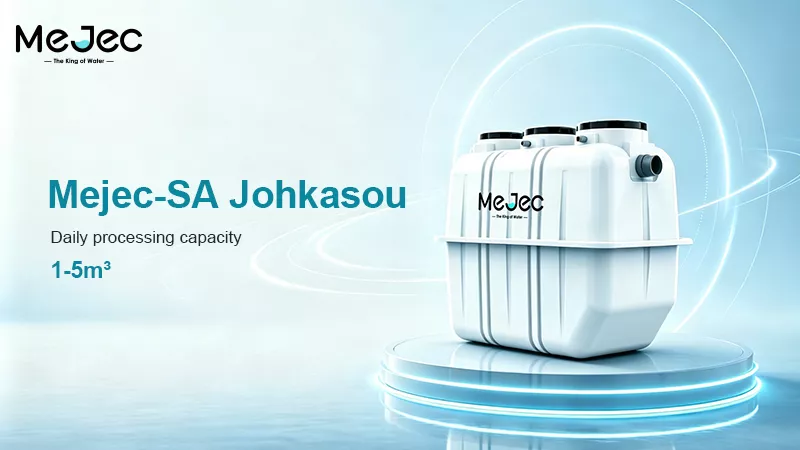
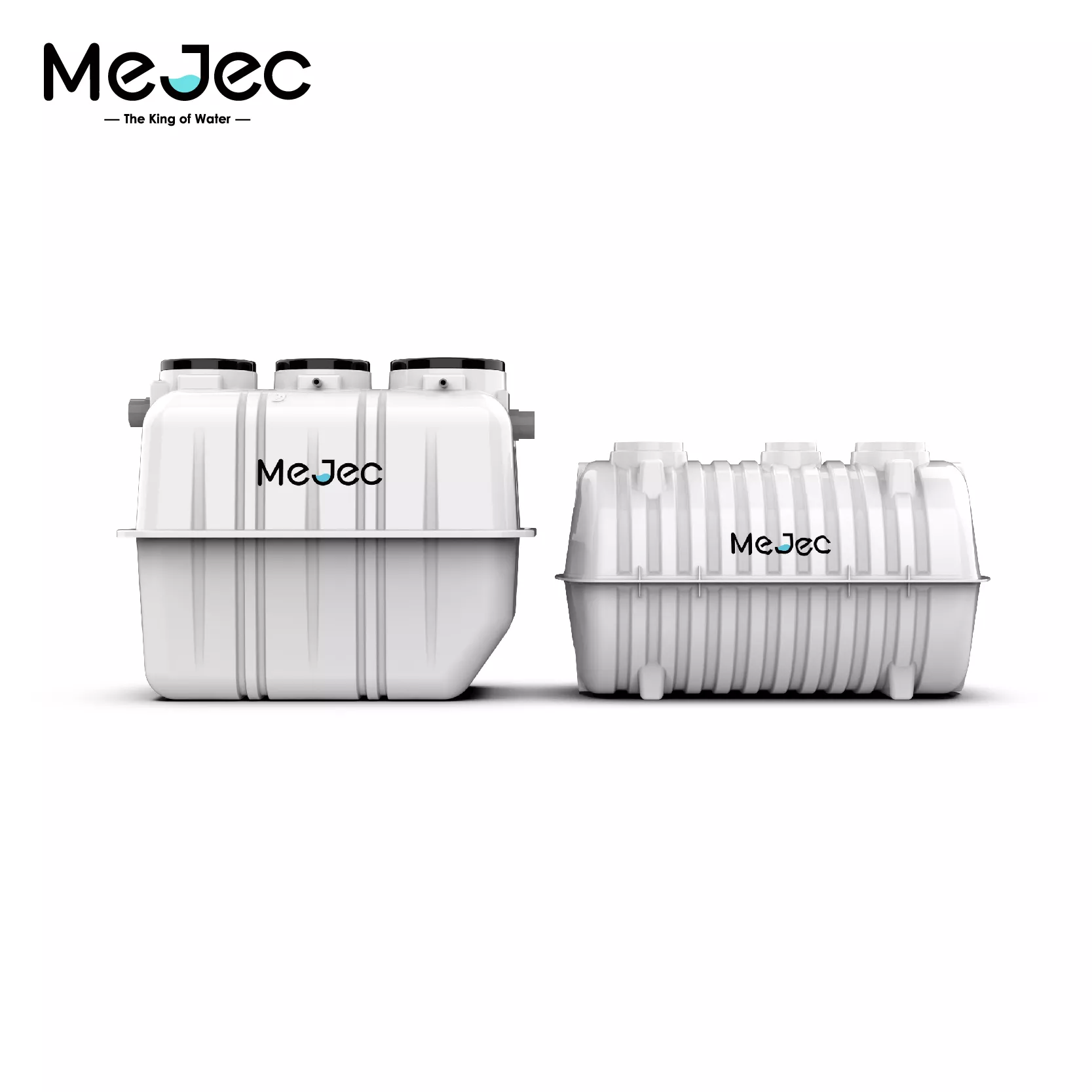
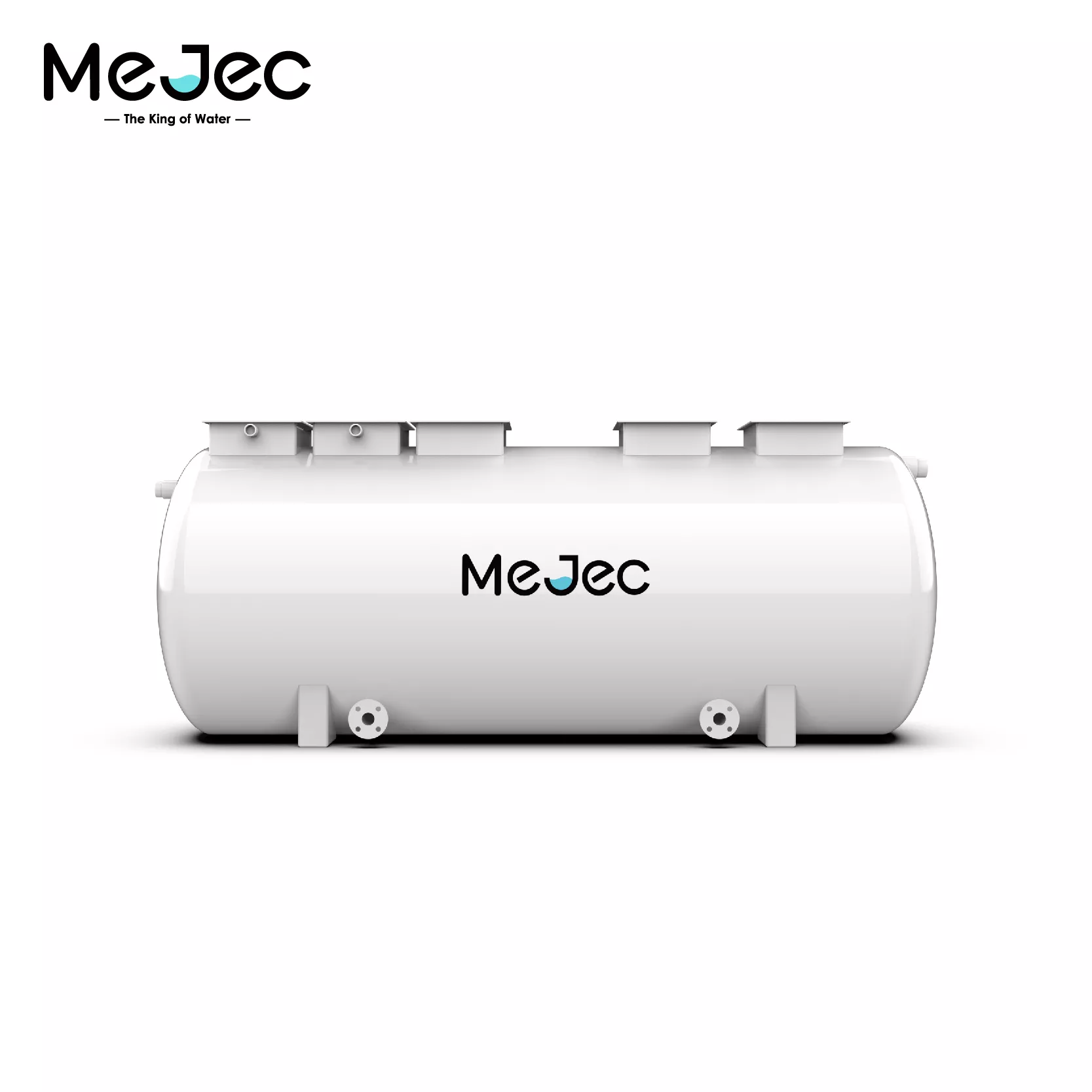
A small capacity johkasou is not a scaled-down septic tank. It is a factory-built, buried biological treatment unit rated in cubic metres per day rather than in bedrooms, and it includes a blower-driven aerobic chamber — the component a septic tank does not have. Units in the "small" band typically cover 1 to 5 m³/d: a single household, a villa, a small homestay, a staff canteen, or a remote site where connecting to a sewer is not an option. This guide does three things: it translates "small capacity" into your real daily flow, it sets out what the site must provide, and it lists the maintenance duties you are signing up for.
.webp)
What "small capacity" means in numbers
Johkasou capacity is quoted as daily treatment flow, not as a number of people. That is where buyers usually get stuck: Japanese product literature still uses the older "5-person tank" wording, while international project teams think in m³/d, litres per minute, or bedroom counts. The two conventions are connected by a population estimation standard — in Japan, JIS A 3302 sets out how the design population for a johkasou is calculated.
For a unit in the small band, the published range looks like this:
Daily capacity | Footprint (L × W × H, m) | Weight (kg) | Installed power (kW) |
|---|---|---|---|
1 m³/d | 1.65 × 1.00 × 0.98 | 180 | 0.025 |
2 m³/d | 1.86 × 1.10 × 1.37 | 260 | 0.038 |
3 m³/d | 1.95 × 1.10 × 2.25 | 300 | 0.055 |
5 m³/d | 2.25 × 1.45 × 2.25 | 350 | 0.075 |
Source: Mejec-Johkasou-SA published specifications; parameters are indicative and confirmed per project.
Read the power column before you read the price. A 5 m³/d unit drawing 75 W runs continuously on about as much electricity as a light bulb, because the treatment is biological rather than mechanical. The number to plan around is therefore not the electricity bill but the maintenance routine and the desludging interval.
Sizing note. A common rule of thumb for domestic wastewater design is roughly 200 litres per person per day. On that assumption, 1 m³/d corresponds to about five people and 5 m³/d to roughly twenty-five. Treat this as a starting estimate only. Real projects differ because of kitchen and laundry load, seasonal occupancy and local design codes, so confirm the figure against the code you are required to follow — and against the population estimation method your regulator recognises — before selecting a model.
If you want to see how these four capacities are configured as products, the Mejec-Johkasou-SA specifications set them out unit by unit.
How a small johkasou treats wastewater
The process runs through four stages, and they are the reason a johkasou is not a septic tank.
Anaerobic filter chamber. Solids settle and are retained on a media bed, where anaerobic microorganisms begin breaking down dissolved matter.
Contact aeration chamber. A blower supplies air, and aerobic microorganisms attached to the media consume the remaining organic load. This is the stage a septic tank does not have.
Sedimentation chamber. Sludge is separated and the clear supernatant passes on.
Disinfection. The treated water is chlorinated before discharge.
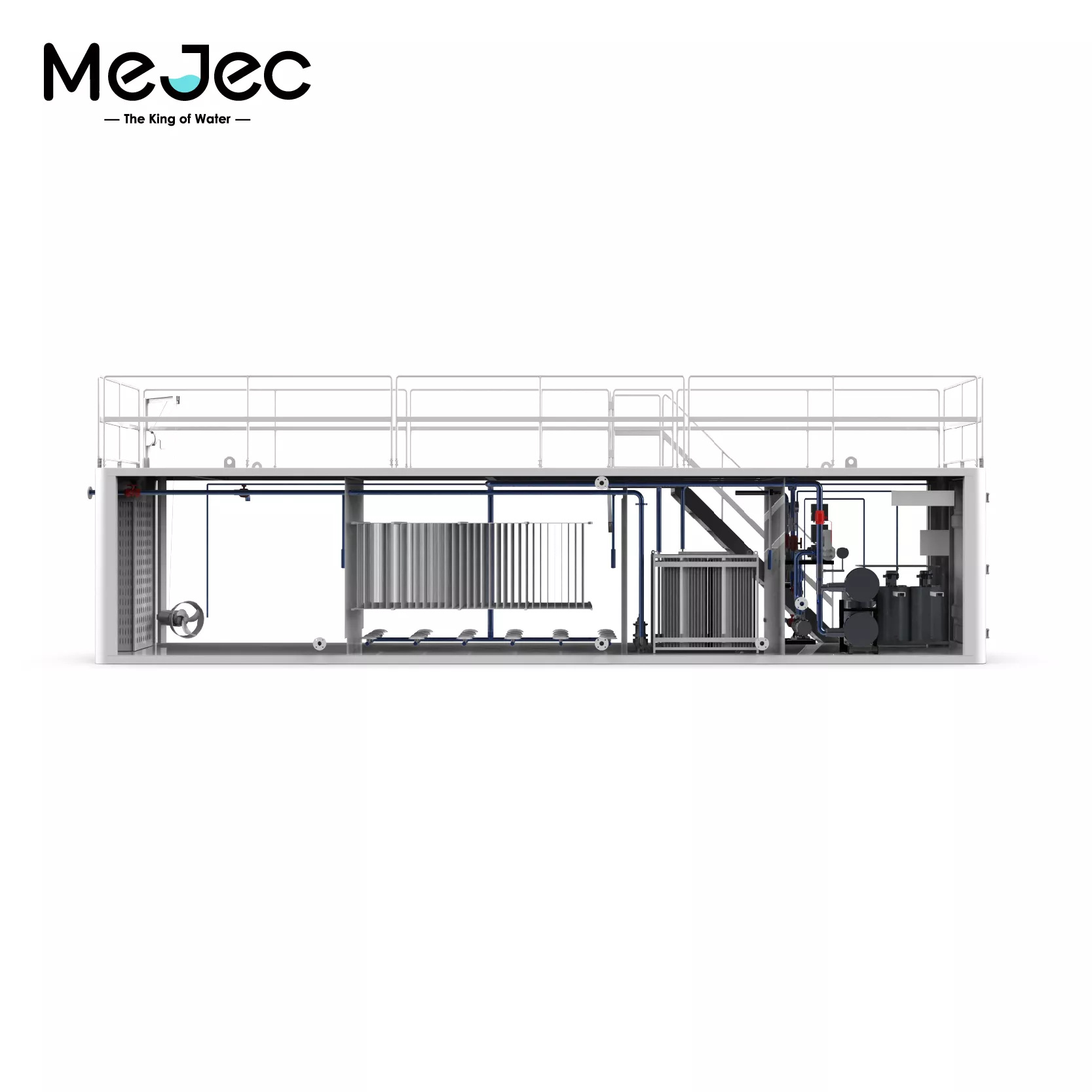
The internal geometry varies — a sedimentation chamber can replace the anaerobic filter bed, and a moving bed can replace fixed contact media — but the treatment function is essentially the same. The Johkasou structure described by Japan's Education Center of Environmental Sanitation walks through the same four stages.
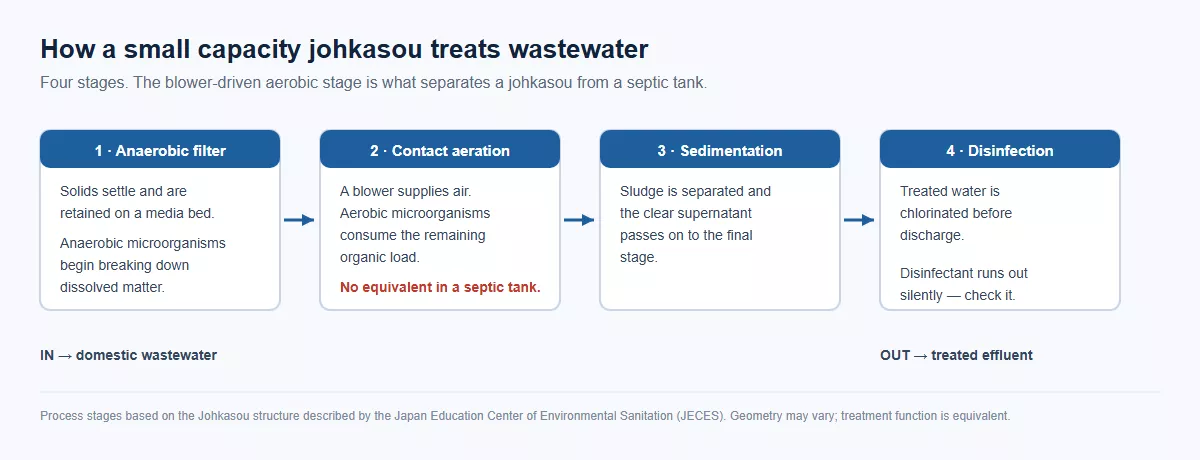
Figure 1. The four treatment stages of a johkasou. The blower-driven aeration stage is what a septic tank does not have.
The measurable difference shows up in effluent quality. Japan's Ministry of the Environment publishes results from its statutory Article 11 inspections, and in one survey covering roughly 590,000 units, about 40% of the johkasou inspected produced effluent with BOD at or below 5 mg/L — clean enough that the official commentary compares it to water suited to carp and crucian carp. Two cautions: that is a distribution across installed units rather than a guaranteed output for any single unit, and it reflects systems whose maintenance was kept up. What it does show is what the aerobic stage buys you when the routine is followed.
Because the process depends on living microorganisms, performance depends on how the unit is used and maintained, not only on how it is built.
Johkasou vs septic tank vs larger integrated plant
| Small capacity johkasou (1–5 m³/d) | Septic tank | Larger integrated / containerised plant |
|---|---|---|---|
Treatment principle | Anaerobic plus aerobic biological treatment with blower | Settling and anaerobic digestion | Multi-stage biological treatment (MBBR/MBR and similar) |
Effluent stability under variable load | Stable: the aerobic stage keeps working as load changes | Variable; depends heavily on retention time and desludging | Stable, with more instrumentation and controls |
Statutory obligations (Japan) | Periodic maintenance, desludging and statutory inspection | A lighter regime in most jurisdictions | Periodic maintenance and inspection |
Footprint | Buried, roughly 1.6–2.3 m long | Comparable or larger | Larger, often container-sized |
Typical use | Single house, villa, homestay, small canteen, remote site | Single house with low-spec discharge | Multiple households, estate, campus, industrial park |
Three rules settle the choice:
Flow, not headcount. If daily flow is under roughly 5 m³/d, a small johkasou is in range. Above that, step up to a larger integrated unit rather than installing several small units in parallel without a hydraulic review.
Maintenance capability. The aerobic stage is only as good as the maintenance behind it. If no one can be made responsible for periodic checks and desludging, choose the simplest system that meets the discharge standard rather than the most advanced one.
Discharge standard. Where limits on BOD, nitrogen or phosphorus are strict, the aerobic and, where required, denitrification stages matter most — and this is precisely where a johkasou and a passive tank diverge.
Sizing it right: the four inputs you need
Before any supplier can quote a model, four facts must be settled. Getting them wrong is the most common cause of an undersized system.
Population and occupancy pattern. Not the headcount on paper, but who is actually there. A family of four year-round behaves very differently from a twelve-bed homestay that is full for four months.
What is connected. Toilet wastewater only, or toilet plus kitchen plus laundry? A full domestic connection can more than double the hydraulic and organic load compared with blackwater alone.
Peak and seasonal flow. Design on the peak day, not the annual average. Seasonal sites should be sized on their peak week.
Discharge standard and site constraints. Required effluent quality determines the process configuration; available footprint and the water table determine the model and the installation method.
Three mistakes appear again and again:
Sizing by bedrooms or by the "person tank" label instead of by calculated daily flow.
Leaving kitchen wastewater out of the calculation, then finding the unit short of capacity in service.
Choosing on headline capacity alone, ignoring footprint, buried depth and the space needed for maintenance access.
In Japan, the size and structure of johkasou are governed by law and factory products pass through a national type-approval system, which is why a compliant unit is a known quantity. The model selection guidance makes the same point for buyers. Projects elsewhere should apply the local equivalent: state the design flow, the connected fixtures and the discharge standard in the enquiry, and ask the supplier to justify the model against them.
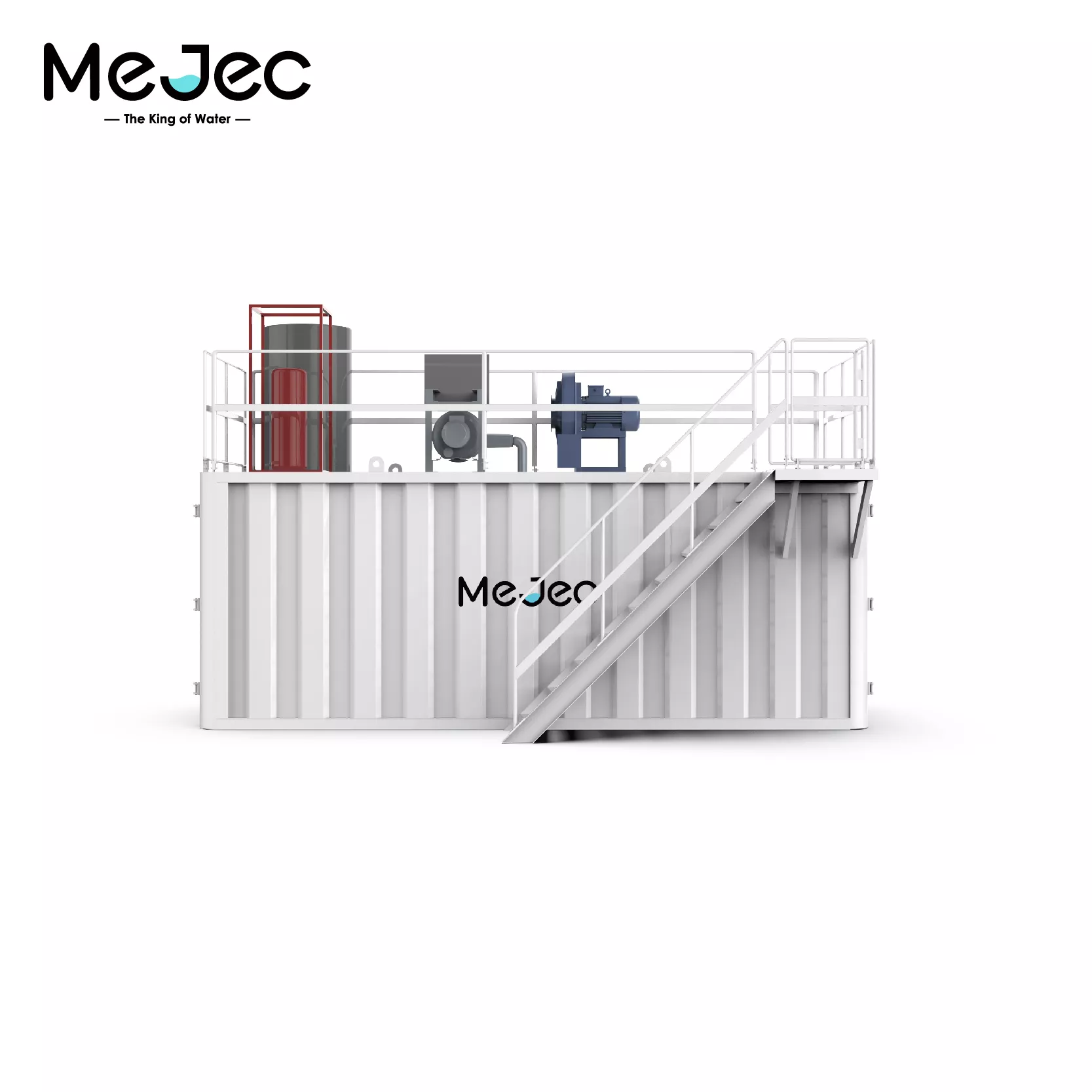
For sites with more than one building or a mix of uses, it is worth comparing a single small unit against a packaged wastewater treatment solution before committing to a layout.
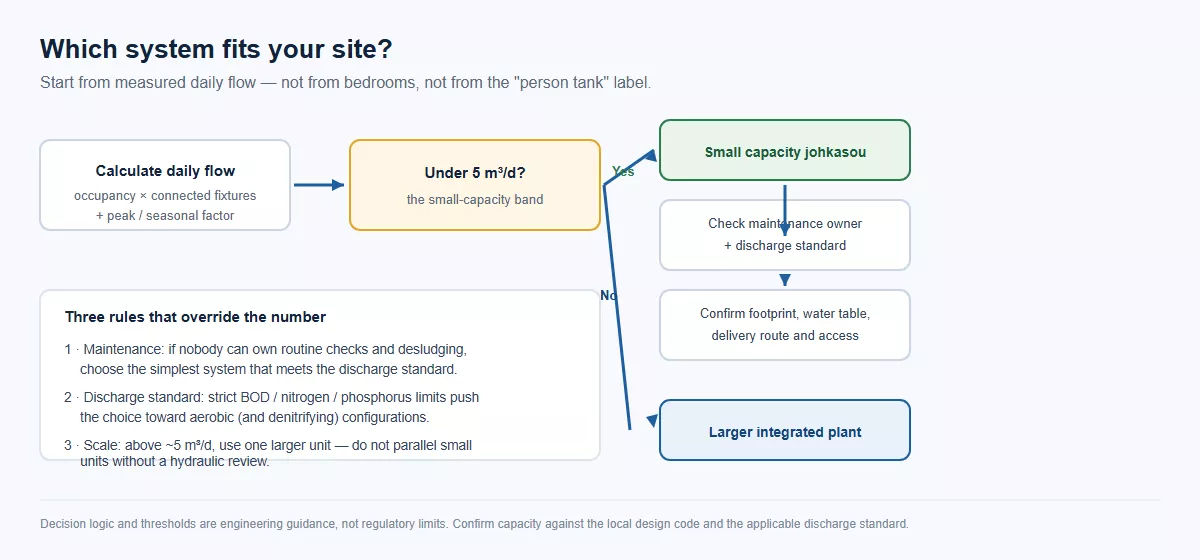
Figure 2. Sizing decision flow: start from measured daily flow, then check maintenance capability and discharge standard.
What the site and installation require
A small johkasou arrives as a factory-built tank and is buried, so most of the critical work happens before anything reaches the site.
Footprint. In the 1–5 m³/d band the unit itself is roughly 1.65 to 2.25 m long and 1.00 to 1.45 m wide. Japanese guidance describes the installation area as no more than the space of one passenger car.
Time. Installation is measured in days rather than weeks — official Japanese material puts the work at about one week, after which the unit is ready for use.
Access. The real constraints are rarely the tank: they are the delivery route, the lifting point, the trench depth and the water table. Settle all four before ordering.
Maintenance access. Keep the inspection openings reachable. A buried unit that cannot be accessed for desludging is a liability rather than an asset.
Competent installation. In Japan, installation must be carried out by a certified johkasou installation worker. For export projects the equivalent safeguard is a supplier-provided installation manual plus commissioning support from the manufacturer.
.webp)
Operation and maintenance: what you are signing up for
Johkasou maintenance is not optional housekeeping. In Japan it is a legal obligation with three distinct workstreams.
Workstream | What it covers | Frequency (Japan) |
|---|---|---|
Operation and maintenance | Checking and adjusting water flow and disinfectant; checking, adjusting and repairing equipment such as blowers | Required by the Johkasou Act, starting immediately before commissioning, then periodically |
Desludging (cleaning) | Removing accumulated sludge from the tank | Periodically, by a registered contractor |
Statutory inspection | Independent verification that treatment performance is maintained | First inspection 3–5 months after start of use, then once a year |
The Act requires periodic operation, maintenance and cleaning to technical standards, with records kept for three years, and it obligates the owner to undergo regular statutory inspection. The installation-stage water quality inspection is known as the Article 7 inspection; the recurring annual one is the Article 11 inspection. The maintenance requirements are summarised here, and the legal texts are published by the Ministry of the Environment.
For a project outside Japan, the useful translation is not the statute itself but the structure behind it. Write four things into the O&M plan and the supply contract:
A named responsible person for routine checks — not "the maintenance team".
A desludging interval and a contractor, agreed before commissioning rather than after the first complaint.
A disinfectant replenishment routine, because the final stage is chemical and runs out silently.
Record keeping, so that when something changes — a smell, a colour, a slow drain — there is a baseline to compare against.
Units that fail early are rarely badly built. They are usually units whose blower stopped, whose sludge was never removed, or whose disinfectant was never refilled. If you want to see how these routines and configurations work out across different site types, our project case studies include household johkasou installations, staff accommodation and remote-site projects.
What drives the cost
Japan publishes a reference point: a 5-person johkasou, including the equipment and its installation, is quoted at approximately ¥840,000, and subsidy and financing schemes exist to reduce the owner's share. Two caveats apply. The figure comes from official public information material and carries no date, and it reflects Japanese labour and civil works — so read it as an order of magnitude, not a quotation.
For an export project, cost is driven by five items, and only the first is equipment:
Model and material — capacity, wall thickness, resin or steel construction, and whether denitrification is required.
Freight and clearance — a buried tank ships as a large-volume item, so shipping is a meaningful share of the total.
Excavation and civil works — local, and usually the largest single swing factor.
Electrical and discharge connections — a small power draw, but a real installation cost.
Maintenance contract — the recurring cost that determines total cost of ownership over the unit's service life.
Ask for a quotation that separates those five lines. A single lump-sum price makes it impossible to compare two suppliers honestly.
The three numbers that decide it
Reduce the decision to three figures:
Daily flow in m³/d, calculated from real occupancy and real connected fixtures.
Footprint in metres, including maintenance access and the delivery route.
Maintenance load in visits per year, and who performs them.
If those three align with your site, the specification is sound. If any one of them is being estimated rather than calculated, that is the number to fix first.
If you would like a second opinion on a specific site, send us the occupancy, the connected fixtures, the required discharge standard and the available footprint. Our engineers will come back with a recommended capacity and configuration. Request a sizing assessment →
FAQ
Is a johkasou just a septic tank?
No. Both are buried on-site tanks, but a johkasou adds a blower-driven aerobic chamber and a disinfection stage, and in Japan it carries statutory maintenance and inspection obligations. That is why its effluent quality is more stable when occupancy fluctuates.
How long does installation take?
Japanese official material describes installation as about one week's work, with an installation area no larger than the space of a single passenger car. The variable is not the tank but the delivery route, the excavation and the water table.
How often does it need servicing?
In Japan, operation and maintenance plus desludging run on the interval set by the technical standards, and a statutory inspection is due first at 3–5 months after commissioning and annually thereafter, with records kept for three years. Outside Japan, set the interval with your supplier and write it into the O&M contract.
How long does it last?
Factory-built johkasou are described in Japanese official material as having a track record of more than 30 years of operation, and as earthquake-resistant: during a water outage the tank retains its function provided it is not damaged.
Which capacity do I need for a small resort or homestay?
As a rule of thumb, work from the peak week rather than the annual average — peak occupancy, plus kitchen and laundry load if they are connected, plus a margin for the discharge standard. In the small band the choice usually falls between 3 and 5 m³/d for a homestay and 1–2 m³/d for a single villa. Send us the numbers and we will confirm.