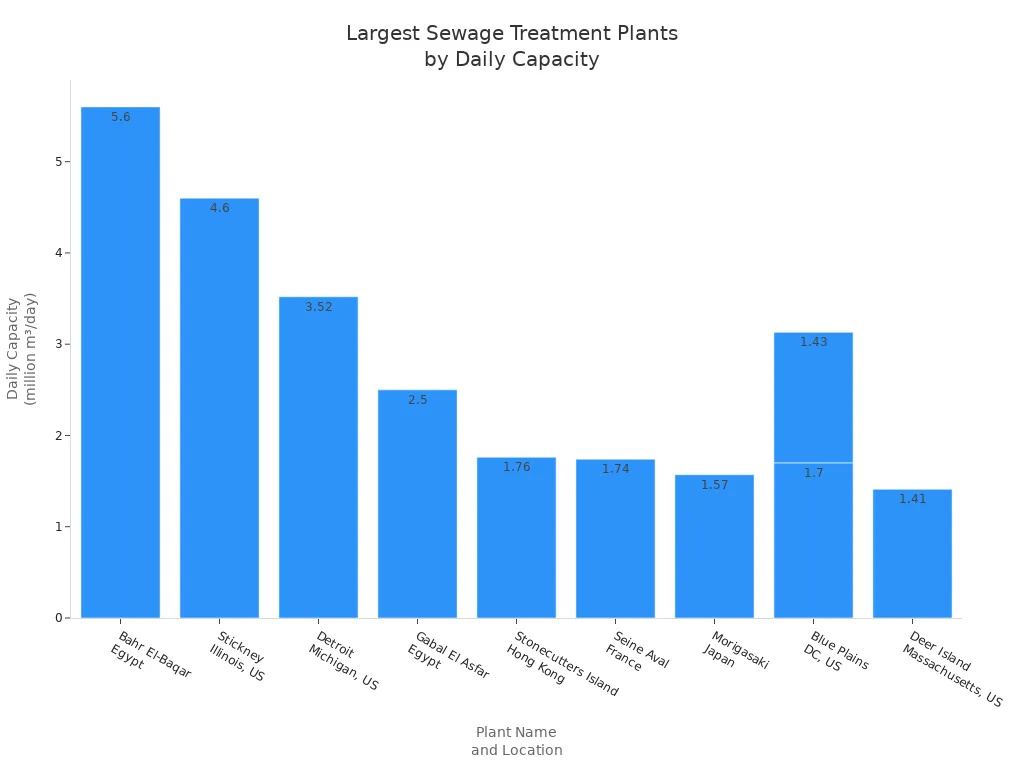
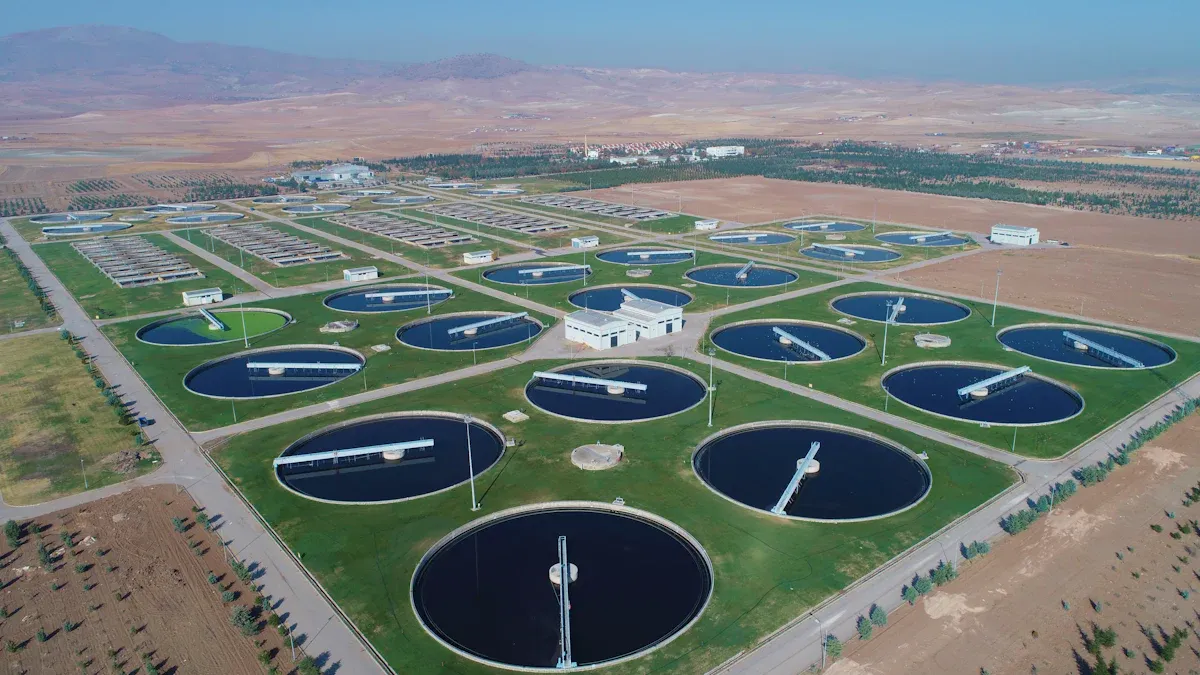
You can see the world’s largest sewage treatment plant in Egypt at Bahr El-Baqar, handling about 5.6 million cubic meters each day. Massive plants impress you with huge capacities and advanced technology. Here’s a quick look at the top 10:
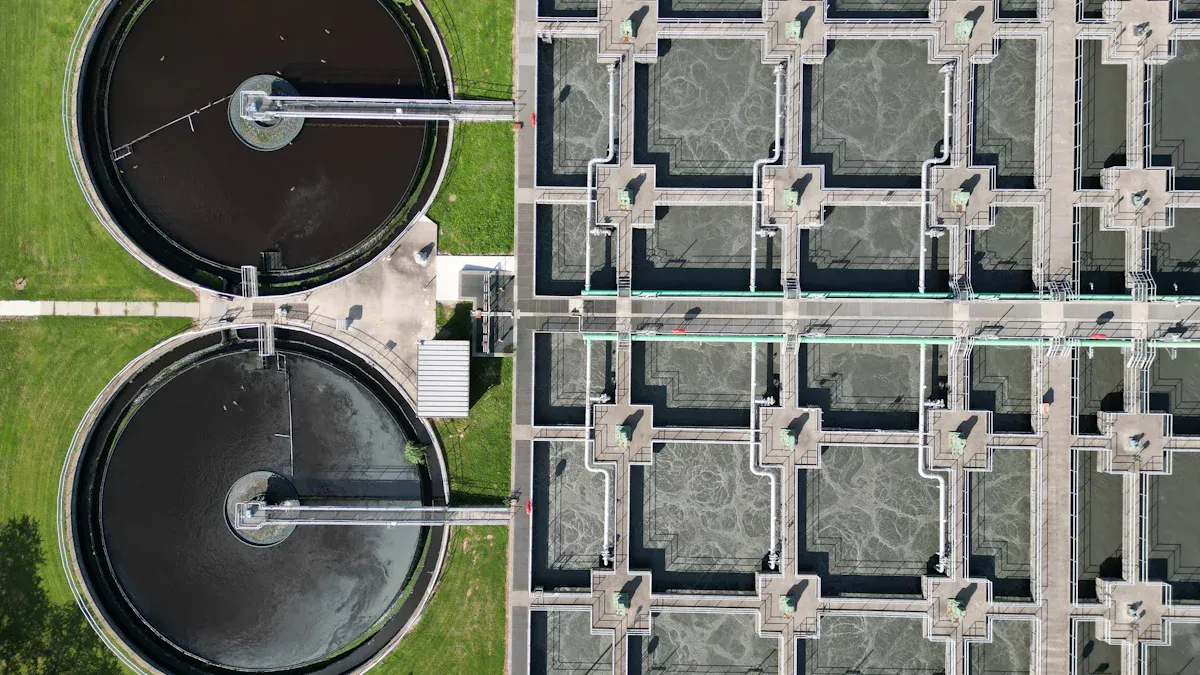
When you look at sewage treatment plants, you notice that size matters. The world's largest sewage treatment plant stands out because it handles huge amounts of wastewater every day. You can measure the scale of a plant by its daily treatment capacity. This number tells you how much water the plant cleans in one day. Plants fall into three main categories based on their size:
Scale
Capacity Range
Small Scale
up to 100 m³/day
Medium Scale
100 m³/day to 1,000 m³/day
Large Scale
1,000 m³/day and above
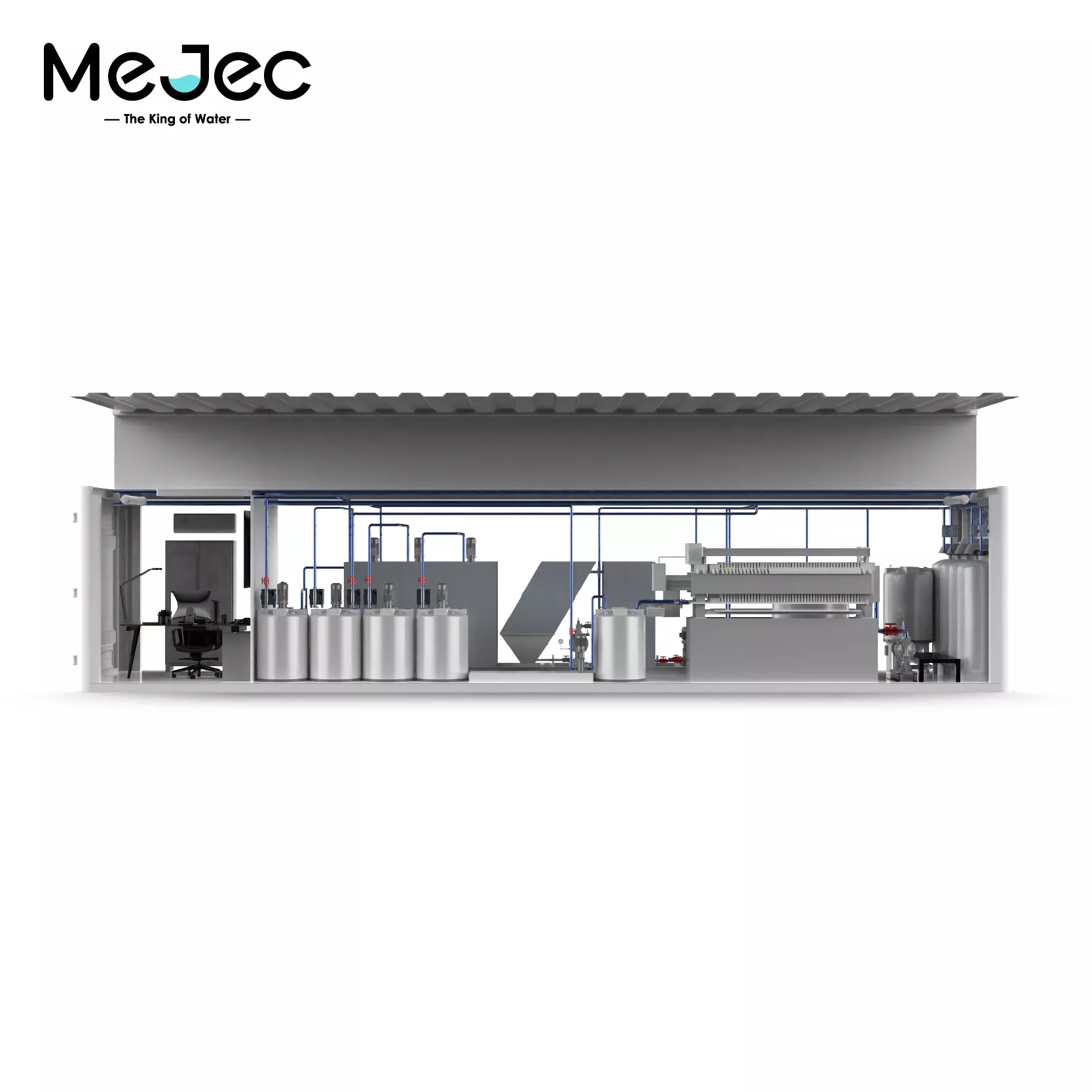
Most massive facilities belong in the large-scale group. You also see different system configurations. Some plants use packaged systems, which arrive ready to install. Others use containerized or skid-mounted systems for easy transport. Traditional modular systems offer flexibility for growing cities.
Configuration
Type of System
Packaged Systems
Modular, pre-assembled units
Containerized Systems
Transportable units
Skid-mounted Systems
Mounted on a skid for mobility
Traditional Modular Systems
Conventional modular setups
Key Factors in Ranking
You rank sewage treatment plants by several important factors. Daily treatment capacity comes first. You also consider the technology used, the plant’s footprint, and the number of people served. Advanced systems clean water more efficiently and help protect the environment. You see that the world's largest sewage treatment plant uses cutting-edge methods to handle massive flows. When you compare plants, you look for those that combine high capacity with smart design and strong performance.
You find the Stickney Water Reclamation Plant in Stickney, Illinois, just outside Chicago. The Metropolitan Water Reclamation District of Greater Chicago owns and operates this facility. It serves the city and many nearby suburbs. You see that the plant covers a large area and plays a key role in protecting local waterways.
Treatment Capacity
Stickney stands out because of its huge size. You notice that it can treat up to 1.4 billion gallons of wastewater every day. On average, it cleans about 700 million gallons daily. This means the plant serves more than 2.3 million people in the region. You can compare its capacity with other major facilities in the table below:
Stickney uses advanced technology to clean water. You discover that the plant has a pilot algae reactor. This system grows algae from wastewater. The algae absorb phosphorus and nitrogen, which helps reduce pollution. Through photosynthesis, the algae also lower the plant’s carbon footprint. You learn that Stickney aims to become carbon neutral by using these sustainable methods. The plant recovers nutrients and offsets carbon emissions, making it a leader in green wastewater treatment.
Serves over 2.3 million people
Uses algae reactors for sustainable treatment
Works toward carbon neutrality
Tip: You can visit the plant’s website to learn more about its environmental programs.
Bahr El Baqar Wastewater Treatment Plant
Location and Ownership
You can find the Bahr El Baqar Wastewater Treatment Plant east of Port Said, Egypt. The Egyptian government owns and operates this facility. It stands as a key part of Egypt’s plan to improve water management and support agriculture in the Sinai Peninsula. You see that the plant’s location helps it serve both urban and rural communities. The government invested in this project to solve water scarcity and boost local farming.
Treatment Capacity
You might wonder how much water this plant can handle each day. The Bahr El Baqar Wastewater Treatment Plant treats about 5.6 million cubic meters of wastewater daily. This number makes it the world’s largest sewage treatment plant. The plant’s huge capacity means you can rely on it to clean water for millions of people and thousands of farms.
Treats approximately 5.6 million cubic meters of water every day
Supports irrigation and drinking water needs for a large region
Key Features and Innovations
You will notice many advanced features at this facility. The plant uses ABB technology to save energy and include renewable sources. It holds three Guinness World Records for its size and technology. You see that it restores 140,000 hectares of farmland and supports local agriculture. The plant uses advanced process controls to manage water treatment efficiently.
2 km of shaftless spiral conveyors move sludge with less energy
UniGear ZS1 switchgear and LV panels provide reliable power
The plant processes 490,000 tons of dry sludge per year at 24% drying and 165,000 tons at 75% drying
Conveyor designs prevent blockages and reduce friction for long life
Note: This plant’s innovations help protect the environment and support Egypt’s food supply.
Atotonilco de Tula Wastewater Treatment Plant
Location and Ownership
You can find the Atotonilco de Tula Wastewater Treatment Plant in Hidalgo, Mexico. The Mexican government owns this facility. It serves Mexico City and nearby areas. You see that this plant plays a major role in cleaning water for millions of people. The location helps the plant collect wastewater from a large urban region.
Treatment Capacity
You might wonder how much water this plant can treat every day. The Atotonilco de Tula facility handles huge volumes of wastewater. You can check the table below to see its capacity:
Capacity Type
Flow Rate (m³ per second)
Daily Capacity (m³ per day)
Nominal Average
35
3,024,000
Maximum
50
3,628,800
This plant ranks among the top facilities in the world. You notice that its maximum daily capacity reaches over 3.6 million cubic meters. The plant helps Mexico City manage its wastewater and protect the environment.
Key Features and Innovations
You will find many advanced features at Atotonilco de Tula. The plant uses modern technology to save energy and reduce pollution. Here are some highlights:
The facility has 24 tanks for biological treatment and 24 tanks for water clarification.
Sludge from the treatment process goes through anaerobic digestion. This produces biogas.
The plant uses biogas to generate electricity. You see that it covers about 60% of its energy needs this way.
Cogeneration engines help turn methane gas into power for daily operations.
These innovations make the plant efficient and environmentally friendly. You can compare its technology with the world's largest sewage treatment plant to see how modern systems improve water quality and energy use.
Abu Rawash Wastewater Treatment Plant
Location and Ownership
You can find the Abu Rawash Wastewater Treatment Plant northwest of Cairo, Egypt. The Egyptian government owns and operates this facility. You see that the plant serves a large part of the Greater Cairo area. Its location helps you understand why it plays a vital role in protecting the Nile River and supporting local communities.
Treatment Capacity
You notice that Abu Rawash treats about 1.6 million cubic meters of wastewater every day. This huge capacity means the plant serves more than 9 million residents. You can compare its size with other major facilities, but you will see that it stands out in Africa and the Middle East. The plant uses a dual-stage treatment process. This system cleans water so you can safely discharge it or reuse it for agriculture. You learn that the plant plans to expand its capacity by 400,000 cubic meters per day. This future growth will help meet the needs of a growing population.
Key Features and Innovations
You discover several advanced features at Abu Rawash. The plant uses reliable power systems to keep operations running smoothly. Twelve Cummins C 2500 HD 5A generators, powered by QSK 60G8 engines, supply electricity. You see that this setup ensures the plant works even during power outages. The total investment reached 6.2 billion Egyptian pounds, showing a strong commitment to sustainable water management. You can review the table below to learn more about the plant’s innovations:
Innovation Type
Description
Treatment Capacity
Treats 1.6 million cubic meters daily, serving over 9 million residents.
Treatment Process
Dual stage system for safe discharge and agricultural reuse.
Power Supply
12 Cummins generators with QSK 60G8 engines for reliable operation.
Future Expansion
Plans to add 400,000 cubic meters per day to meet future demand.
You see that Abu Rawash uses technology and planning to support clean water for millions. The plant does not match the world's largest sewage treatment plant, but it sets a high standard for innovation in the region.
Deer Island Waste Water Treatment Plant
Location and Ownership
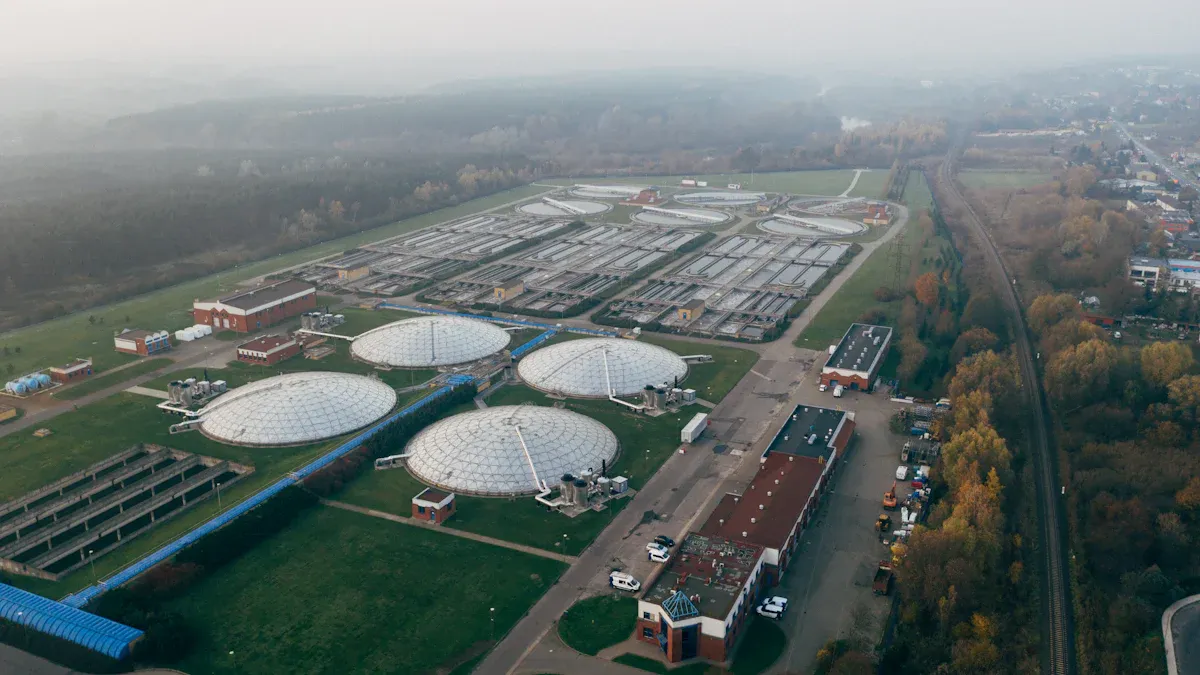
You find the Deer Island Waste Water Treatment Plant in Boston Harbor, Massachusetts. The Massachusetts Water Resources Authority owns and operates this facility. It serves the Greater Boston area and helps protect the harbor from pollution. You can see the plant’s large domes from many parts of the city. The location on an island allows the plant to use natural tidal currents in its operations.
Treatment Capacity
You might wonder how much water Deer Island can handle each day. The plant manages a huge volume of wastewater.
Daily treatment capacity: Approximately 4.8 million cubic meters per day
Peak flow capacity: Up to 1.27 billion gallons per day
Daily average processing scale: 1.41 million cubic meters per day
Peak processing scale: 4.92 million cubic meters per day Deer Island stands as the second-largest sewage treatment plant in the world. You can compare its size to the world's largest sewage treatment plant and see how both facilities play a vital role in keeping water clean for millions of people.
Key Features and Innovations
You notice that Deer Island uses advanced technology to solve environmental problems. The plant’s design lets it discharge treated water continuously because strong tidal currents carry the water away. This system means you do not need large storage tanks. The innovation helps prevent sewage overflow and keeps Boston Harbor cleaner. Over the years, the plant has improved to meet the needs of a growing population and stricter environmental rules.
Note: Deer Island’s unique approach to wastewater treatment shows how smart design can protect both people and nature.
Blue Plains Advanced Wastewater Treatment Plant
Location and Ownership
You can find the Blue Plains Advanced Wastewater Treatment Plant in Washington, D.C. The District of Columbia Water and Sewer Authority, also known as DC Water, owns and operates this facility. You see that Blue Plains serves the entire Washington, D.C. metropolitan area. The plant helps keep the Potomac River clean and supports more than two million residents. Its location near the river makes it important for protecting local water sources.
Treatment Capacity
You might wonder how much wastewater Blue Plains can treat every day. The plant stands out because of its huge size and advanced systems. You can check the table below to see its daily treatment capacity:
Capacity
Description
Approximately 370 million gallons per day
Largest advanced wastewater treatment facility in the world, serving over 2 million residents in the Washington, D.C. metropolitan area.
You notice that Blue Plains ranks among the top facilities worldwide. Many experts compare it with the world's largest sewage treatment plant because of its impressive scale and technology.
Key Features and Innovations
You discover that Blue Plains uses some of the most advanced treatment technologies. The plant focuses on cleaning water and recovering energy. Here are some of the main features:
Technology
Description
Sludge Thermal Hydrolysis (Cambi)
Enables gas production through anaerobic digestion, significantly improving energy recovery.
Nitrification and Denitrification
Two-stage process for removing BOD and nutrient removal.
Cogeneration
Achieves energy recovery of 13 MW from sludge, enhancing the plant's energy efficiency.
You see that these systems help Blue Plains reduce pollution and save energy. The plant produces electricity from sludge and removes harmful nutrients before releasing water back into the river. You learn that Blue Plains sets a high standard for wastewater treatment in the United States.
Tip: You can explore more about how advanced technology helps protect rivers and communities.
Hyperion Water Reclamation Plant
Location and Ownership
You can find the Hyperion Water Reclamation Plant in the southwestern part of Los Angeles, close to Santa Monica Bay. The City of Los Angeles owns and operates this facility. The plant covers an area of 0.58 square kilometers. You see that Hyperion began operation in 1925 and has grown over time to meet the needs of a large city. The location near the coast helps the plant manage wastewater from homes, businesses, and industries across Los Angeles.
Treatment Capacity
You might wonder how much wastewater Hyperion can treat each day. The plant has a daily treatment capacity of 3.785 million cubic meters. This huge volume means Hyperion ranks among the largest sewage treatment plants in the world. You see that the plant handles municipal sewage, industrial wastewater, and some rainwater. Hyperion’s capacity helps protect local beaches and supports a healthy environment for millions of people.
Daily treatment capacity: 3.785 million cubic meters
Serves the entire Los Angeles metropolitan area
Processes sewage, industrial waste, and rainwater
Key Features and Innovations
You notice that Hyperion uses advanced systems to clean water and protect the environment. The plant has expanded several times, reaching its current size after upgrades in 1950 and 1985. You can review the table below to learn more about Hyperion’s features and innovations:
Feature/Innovation
Description
Location
Southwestern Los Angeles, near Santa Monica Bay
Area
Covers 0.58 km²
Operational Start
Began operation in 1925
Capacity
Processes 3.785 million m³/d after major expansions
Sewage Sources
Handles municipal, industrial, commercial wastewater, and some rainwater
You see that Hyperion stands out for its size, technology, and history. The plant does not match the world's largest sewage treatment plant, but it plays a vital role in keeping Los Angeles clean and safe.
Detroit Wastewater Treatment Plant
Location and Ownership
You find the Detroit Wastewater Treatment Plant on the banks of the Detroit River in Michigan. The Great Lakes Water Authority owns and operates this facility. You see that the plant serves Detroit and many surrounding communities. Its location helps protect the river and Lake Erie from pollution. You notice that the plant covers a large area and stands as one of the most important infrastructure sites in the Midwest.
Treatment Capacity
You might wonder how much wastewater this plant can handle each day. The Detroit Wastewater Treatment Plant has a primary treatment capacity of 6.45 million cubic meters per day. Its secondary treatment system can process 3.52 million cubic meters per day. These numbers show you that Detroit’s facility ranks among the largest in the world. When you compare it with the world's largest sewage treatment plant, you see that Detroit’s capacity helps keep water clean for millions of people.
The plant’s huge size means it can treat water from homes, businesses, and industries across the region.
Key Features and Innovations
You discover that Detroit uses advanced technology to clean water and protect the environment. The plant combines several systems to remove pollutants and ensure safety. Here is a table showing some of the main technologies and strategies:
Technology/Strategy
Description
Primary Treatment System
Capacity of 6.45 million m³/d, includes pretreatment and biological treatment processes.
Ferric Chloride Dephosphorization
Used for the removal of phosphorus from wastewater.
Pure Oxygen Aeration Activated Sludge
Secondary treatment method that enhances the efficiency of biological treatment.
Filtration and Disinfection
Final steps before discharge, ensuring treated water meets safety standards.
Main Structures
Includes 12 rectangular clarifiers, 6 circular clarifiers, 4 pure oxygen activated sludge tanks, and 25 secondary sedimentation tanks.
You see that these innovations help Detroit meet strict environmental standards and serve a large population.
Beijing Gaobeidian Wastewater Treatment Plant
Location and Ownership
You find the Beijing Gaobeidian Wastewater Treatment Plant in the southeastern part of Beijing, China. The Beijing Drainage Group owns and operates this facility. The plant sits close to the city center, making it important for urban water management. You see that it serves millions of residents and businesses in the capital. The location helps the plant collect wastewater from many districts and protect local rivers.
Treatment Capacity
You might wonder how much water this plant can clean every day. The Gaobeidian facility treats up to 1 million cubic meters of wastewater daily. This huge capacity makes it one of the largest plants in Asia. You notice that the plant supports more than 4 million people in Beijing. The advanced systems help the city meet strict environmental standards. You can compare its size with other major facilities around the world.
Facility Name
Daily Treatment Capacity (m³)
Gaobeidian Plant
1,000,000
Stickney Plant
4,600,000
Bahr El Baqar Plant
5,600,000
Key Features and Innovations
You discover that Gaobeidian uses advanced technology to protect the environment. The plant works hard to remove harmful chemicals from wastewater. Researchers measured organochlorine pesticides (OCPs) and polychlorinated biphenyls (PCBs) in water and sediments from the plant’s effluent. This shows you how the facility manages pesticide contamination in the area. The plant uses special treatment processes to reduce pollution and keep rivers clean.
Advanced systems remove pesticides and industrial chemicals.
The plant monitors water quality to protect aquatic life.
Modern treatment methods help meet strict safety standards.
Tokyo Metropolitan Area Central Wastewater Treatment Plant
Location and Ownership
You find the Tokyo Metropolitan Area Central Wastewater Treatment Plant in the heart of Tokyo, Japan. The Tokyo Metropolitan Government owns and operates this facility. The plant sits close to major business districts and residential areas. You see that its location helps serve millions of people living and working in the city. The government built this plant to keep Tokyo’s rivers and bays clean.
Treatment Capacity
You might wonder how much wastewater this plant can handle every day. The Tokyo Metropolitan Area Central Wastewater Treatment Plant treats about 1.34 million cubic meters of sewage daily. This huge volume means you rely on the plant to keep water safe for more than eight million residents. The facility uses advanced systems to manage large flows from homes, schools, and businesses. You notice that the plant’s capacity ranks among the largest in Asia.
Key Features and Innovations
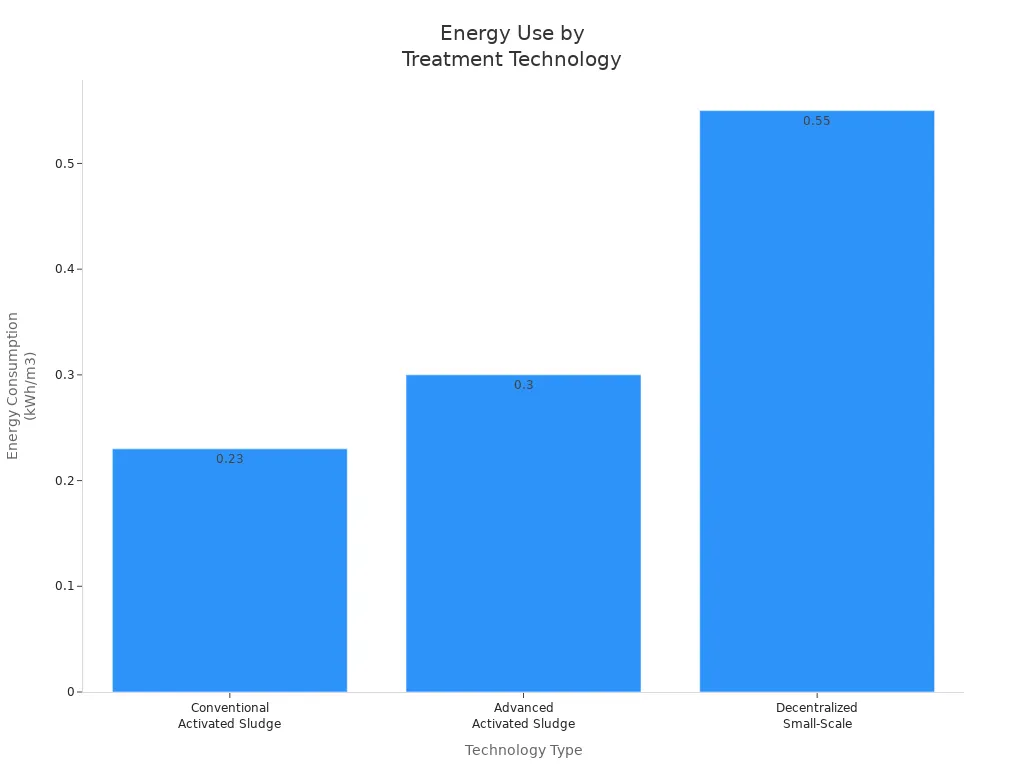
You discover that Tokyo’s central plant uses several advanced technologies. The facility combines conventional and advanced activated sludge systems to clean water. You see that the advanced system removes more nutrients but uses more energy. The plant also uses the Anammox process, which helps remove nitrogen with less energy and sludge. This innovation makes the plant more efficient and environmentally friendly.
Technology Type
Energy Consumption (kWh/m³)
Description
Conventional Activated Sludge System
0.23
Standard method for treating municipal wastewater.
Advanced Activated Sludge System
0.30
Enhanced system for nutrient removal, more energy-intensive than conventional systems.
Decentralized Small-Scale System
0.55
Less efficient for large volumes, suitable for smaller wastewater treatment needs.
Anammox Process
N/A
Innovative nitrogen removal method that significantly reduces energy and sludge production.
Tip: You can see how Tokyo’s plant uses smart technology to save energy and protect the environment.
You see the world's largest sewage treatment plant as vital for cities and public health. These facilities help track disease, lower costs, and reduce greenhouse gas emissions.
Wastewater data guides health decisions.
Natural systems save money and protect the environment.
Innovation and expansion remain essential for future water management.
FAQ
What makes a sewage treatment plant "massive"?
You see a plant as massive when it treats millions of cubic meters of wastewater daily. Large plants also use advanced technology and serve millions of people.
How do these plants help protect the environment?
You help the environment by using these plants. They remove harmful substances from water and reduce pollution. Many facilities also recover energy and nutrients.
Can you visit a sewage treatment plant?
You can visit some plants. Many offer guided tours for students and families. Check the plant’s website for visitor information and safety rules.
Tracy is a seasoned international marketing director at Mejec, dedicated to building global client networks and driving the market adoption of sustainable water solutions. Her expertise lies in connecting cutting-edge technologies with commercial success across diverse regions.
Related Products
We provide you with comprehensive foreign trade solutions to help enterprises achieve global development
Our city's adoption of the technology from the world's largest sewage treatment plant has been transformative. The energy efficiency and effluent quality are unmatched, setting a new standard for our municipal projects.
Sarah Johnson
Plant Operations Manager
4.0
Visiting the facility was an eye-opener. The scale and automation are incredible. While the initial investment is high, the long-term operational savings and environmental compliance it guarantees are well worth it. A benchmark for the industry.
David Rodriguez
Sustainability Consultant
5.0
This plant is a masterpiece of sustainable engineering. Its advanced nutrient recovery and biogas generation processes turn a waste problem into a resource opportunity. It's the model every major city should study.
Lisa Wang
Civil Engineering Director
5.0
As a reference for our coastal megacity project, the design principles and resilience features of this plant are invaluable. It demonstrates that massive capacity and cutting-edge treatment can coexist reliably.
If you have any questions, please feel free to leave us a message
Leave Your Message* Country* Company* Email* Phone* Your Name* Message
Cookies give you a personalized experience,Сookie files help us to enhance your experience using our website, simplify navigation, keep our website safe and assist in our marketing efforts. By clicking "Accept", you agree to the storing of cookies on your device for these purposes. Click "Adjust" to adjust your cookie preferences.For more information, review our Cookies Policy.





.webp)







User Comments
Service Experience Sharing from Real Customers
Michael Chen
Environmental EngineerOur city's adoption of the technology from the world's largest sewage treatment plant has been transformative. The energy efficiency and effluent quality are unmatched, setting a new standard for our municipal projects.
Sarah Johnson
Plant Operations ManagerVisiting the facility was an eye-opener. The scale and automation are incredible. While the initial investment is high, the long-term operational savings and environmental compliance it guarantees are well worth it. A benchmark for the industry.
David Rodriguez
Sustainability ConsultantThis plant is a masterpiece of sustainable engineering. Its advanced nutrient recovery and biogas generation processes turn a waste problem into a resource opportunity. It's the model every major city should study.
Lisa Wang
Civil Engineering DirectorAs a reference for our coastal megacity project, the design principles and resilience features of this plant are invaluable. It demonstrates that massive capacity and cutting-edge treatment can coexist reliably.